
Achieving True Sharp Corners (R = 0) at Waveguide Apertures
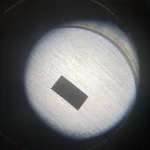
True Sharp Corners (R = 0) for Waveguide Apertures
Achieving True Sharp Corners (R = 0) at Waveguide Apertures Read More »
True Sharp Corners (R = 0) for Waveguide Apertures
Achieving True Sharp Corners (R = 0) at Waveguide Apertures Read More »
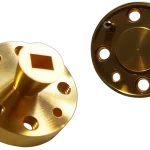
From 0.25 × 0.125 mm Waveguide Apertures to Fully Functional Sub-THz Components
WR1.0 Is Not “Small Size.” It Is “Extreme Manufacturing.”
Manufacturing the WR1.0 Waveguide Ecosystem (750–1100 GHz) Read More »
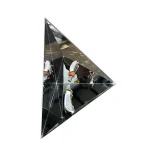
When Surface Smoothness Determines the Success of Astronomical Experiments
Astronomical observatories do not need a “mirror.”
They need a flawless optical surface.
Optical-Grade Multi-Facet Reflection Chamber Read More »
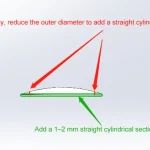
The updated lens geometry provides:
Better clamping stability
Safer and cleaner machining
More reliable inspection
Higher structural strength
Increased yield and lower production risk
No functional performance impact
This is a textbook example of DFM (Design for Manufacturability):
a small structural adjustment that significantly enhances machining feasibility while keeping optical/RF performance intact.
Benefits of the Updated Lens Geometry Read More »
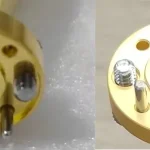
Anti-Cocking Flange VS. Standard Flange: Installation Differences and Performance Impact
Anti-Cocking Flange VS Standard Flange Read More »
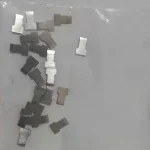
These ultra-small metal components—referred to by the customer as medical blades—are used in high-precision medical devices where reliability, sharpness, and dimensional accuracy are critical.
Precision Wire-EDM Medical Micro Blades Read More »
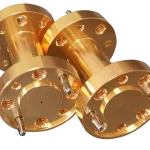
This Engineering Note presents the measured S-parameters (S11 & S21) of a WR2.2 1-inch straight waveguide operating in the 330–500 GHz frequency band. WR2.2 waveguides belong to the sub-millimeter and early THz regime, where electromagnetic behavior is highly sensitive to: Micron-level dimensional accuracy Surface roughness Plating thickness Flange alignment Mode purity Fabrication repeatability The test
WR2.2 1-Inch Straight Waveguide – S-Parameter Performance Analysis (330–500 GHz) Read More »
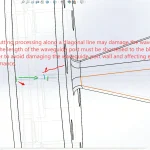
In this waveguide horn antenn component, a slanted through-slot must be cut using Wire-EDM.
However, the original waveguide port extension was too long, and the EDM wire would directly intersect the port wall, causing severe structural damage and RF degradation.
Shortening the Waveguide Port to Avoid Wire-EDM Interference Read More »
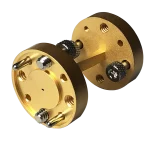
The WR2.8 twist waveguide operates in the 220–325 GHz band.With an internal cross-section of only 0.71 × 0.355 mm, WR2.8 belongs to the Millimeter wave regime where every micron matters. At these frequencies, even a slight geometric deviation—such as a few microns in cavity size or a fractional-degree twist-angle error—will immediately degrade: Insertion Loss Return
Manufacturing Challenges of WR2.8 Twist Waveguides and Our Engineering Solution Read More »
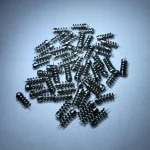
The components shown here are 316L stainless steel micro spring–needle assemblies designed for medical devices that interact directly with biological tissue.
316L Micro Spring–Needle Assemblies for Tissue Interaction Devices Read More »